
What’s Actually Working for Thinning Hair Right Now
There’s a specific moment a lot of our patients describe, standing under the bathroom lights getting ready for a Saturday morning at Falls Park or a Sunday afternoon watching the game, when you notice your part looks a little wider than it used to. Maybe it’s your hairline in the mirror. Maybe it’s the amount of hair left in the shower drain after washing it. Whatever the exact moment was for you, it tends to stick with people longer than they expect it to. Watching your hair change can feel disproportionately upsetting, and if that’s where you are right now, you’re not imagining it, and you’re not alone in feeling that way.
The good news is that hair restoration has genuinely moved forward in recent years. What’s actually working right now isn’t a single miracle product or a one time procedure. It’s a combination approach built around understanding why your hair is thinning in the first place, and that’s exactly what we want to walk you through.
Why Hair Loss Is Rarely Just Genetics
Genetics plays a role in hair loss, no question. But treating genetics as the whole story misses a lot of what’s actually going on for most patients. Hormones, thyroid function, nutrient levels, and stress can all speed up or trigger hair loss that might otherwise have taken years to become noticeable. Someone with a family history of thinning hair might have coasted along fine for another decade if a thyroid issue or a hormone shift hadn’t sped things along.
This is exactly why treating the scalp in isolation, without ever looking at what’s driving the loss underneath, tends to fall short. You can apply every topical treatment on the market, but if an underlying hormonal or nutritional cause is still in play, you’re working against a current that never gets addressed.
Postpartum Hair Loss Is More Common Than You’d Think
We see roughly as many women as men for hair restoration, and postpartum hair loss is one of the most common reasons women come to us in the first place. The hormone shifts after pregnancy can trigger noticeable shedding months after delivery, which catches a lot of new mothers off guard since the timing feels disconnected from the actual pregnancy itself.
Male Pattern Thinning Often Starts Earlier Than People Expect
On the other side, we work with plenty of men noticing recession earlier than they anticipated, along with gradual thinning that’s built up quietly over a few years without them fully registering it until a photo or a comment from a friend makes it obvious. A combination protocol addresses what’s actually driving that pattern rather than just treating the visible symptom on the surface.
Why Bloodwork Comes Before Any Treatment Plan
Before finalizing a hair restoration plan, we want a look at your bloodwork, covering hormones, thyroid function, and a complete blood count at minimum. This isn’t an extra step meant to slow things down. It’s the difference between treating a symptom and actually addressing the cause.
If your thyroid is sitting at the low end of normal, or your hormones are shifted in a way that’s contributing to hair thinning, that needs to be part of the conversation before we ever talk about a specific protocol. Skipping this step means treating your scalp while ignoring a root cause that will keep working against you the entire time.
PRP and Biologics Explained in Plain Terms
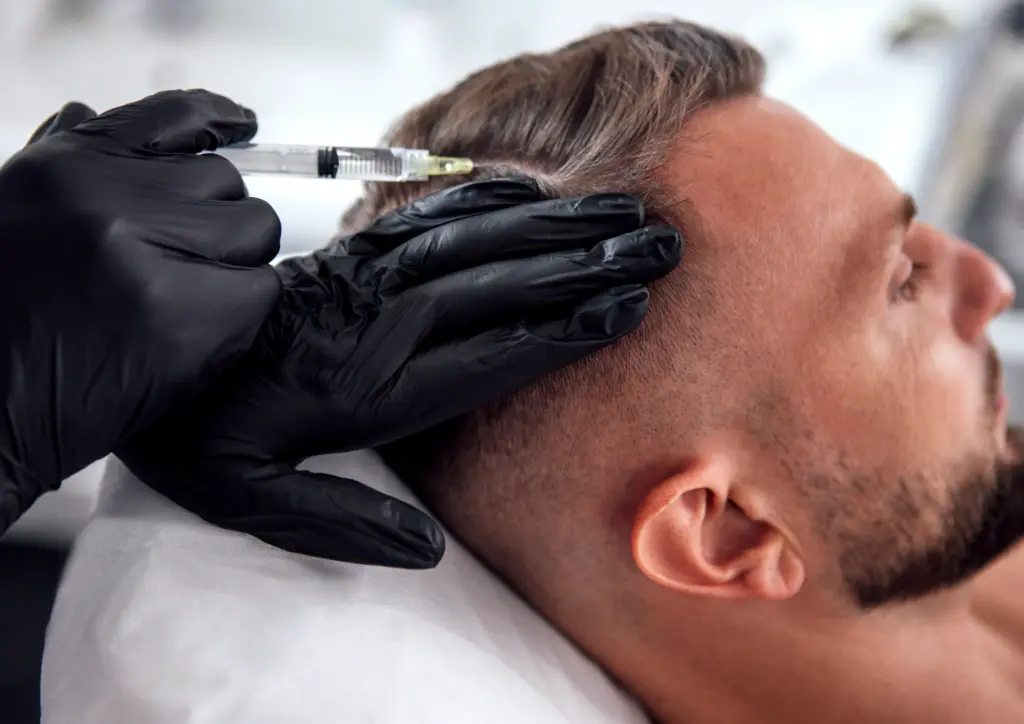
Platelet rich plasma, usually shortened to PRP, uses your own blood’s growth factors to stimulate hair follicles that are still alive but underperforming. Blood is drawn, processed to concentrate the platelets and growth factors, then reintroduced into the scalp in the areas that need support. The idea is simple even if the process sounds technical. Your body already has the tools to support hair growth. PRP concentrates those tools and delivers them exactly where they’re needed most.
Other biologic treatments work on a similar principle, supporting follicles that haven’t fully given up but need help getting back to full function. These aren’t quick fixes, and they’re not meant to be. They’re meant to work with your body’s own repair processes rather than trying to override them with something synthetic.
Why We Pair Biologics With Laser and Ultrasound Therapy
On their own, PRP and biologic treatments do real work. Paired with laser and ultrasound therapy between sessions, results tend to improve further, since these additional therapies support scalp circulation and follicle activity in the gaps between your main treatment appointments. Layering these approaches together tends to outperform any single treatment used in isolation, which is exactly why a real hair restoration protocol rarely relies on just one method.
Realistic Timelines for Regrowth
Hair grows in cycles, and that biological reality doesn’t change no matter how much we might wish it would move faster. A dormant follicle needs real time to wake back up and start producing visible hair again. Most patients notice a difference in shedding and texture within a few months of starting treatment, with more visible density changes typically showing up closer to the six month mark.
Any program promising dramatic regrowth in a matter of weeks is setting an expectation that biology simply can’t keep up with. An honest timeline might feel less exciting to hear upfront, but it’s the difference between a program that’s being straight with you and one that’s selling something it can’t actually deliver.
What a First Visit for Hair Restoration Looks Like
Your first visit starts with a real conversation about when you first noticed changes, what you’ve tried already, and what your specific concerns are, without assumptions made ahead of time. From there, we move into bloodwork covering hormones, thyroid function, and a complete blood count, since treating the scalp without understanding what’s driving the loss rarely gets you the results you’re hoping for.
Once we understand what’s actually going on, we build a combination protocol using PRP or other biologic treatments, paired with laser and ultrasound therapy to support your progress between sessions. From there, ongoing sessions continue with an honest timeline, reassessed regularly as your hair actually responds to treatment.
Who This Approach Is Right For
Whether you’re noticing early thinning around your temples, dealing with postpartum shedding after having a baby, or watching a hairline that’s crept back further than you expected, a combination protocol built around your actual bloodwork tends to serve patients better than a single generic treatment applied the same way to everyone who walks in the door.
We see patients regularly from all across the Upstate, including Greenville, Simpsonville, Five Forks, Montebello, Piedmont, Powdersville, Mauldin, Taylors, River Reserve, Anderson, Woodruff, Greer, and Travelers Rest. Many patients pair hair restoration with acupuncture or a broader wellness consultation, since whole person support alongside a restoration protocol tends to reinforce the results you’re working toward.
A Few Questions We Hear Often
How long before I actually see results?
Most patients notice a difference in shedding and texture within a few months, with more visible density changes closer to the six month mark, since hair growth happens in cycles that can’t really be rushed.
Is hair restoration only for men?
Not at all. We see roughly as many women as men, and postpartum or hormone related hair loss in women is one of the most common reasons patients come to us in the first place.
Do I need bloodwork before starting treatment?
We strongly recommend it. Hair loss connected to an untreated thyroid or hormone issue won’t fully respond to scalp level treatment alone, no matter how consistent you are with it.
What does a typical protocol actually include?
A combination of PRP or other biologic treatments alongside laser and ultrasound therapy, tailored specifically to what’s driving your particular situation rather than a generic package applied to everyone.
Will insurance cover any of this?
Generally no, since these are considered elective, regenerative treatments. We’ll walk through cost and what’s included in detail during your consultation so there aren’t any surprises later on.
Simple Habits That Support Your Protocol Between Visits
Treatment does most of the heavy lifting, but a handful of everyday habits can help your results along between sessions. Being gentle with your scalp matters more than people expect. Aggressive brushing, tight hairstyles worn constantly, and harsh chemical treatments can all add stress to follicles that are already working hard to recover.
Sleep and stress management matter here too, the same way they do with hormones more broadly. Cortisol from chronic stress can interfere with the hair growth cycle, which is part of why some patients notice shedding ramp up during particularly demanding stretches at work or at home, whether that’s a busy season managing a team in Greenville or juggling a new baby during those postpartum months we talked about earlier.
Protein intake deserves a mention as well, since hair is built largely from protein, and a diet that’s consistently too low in it can show up in slower growth and weaker strands over time. None of these habits replace a real protocol built around your bloodwork, but paired with PRP, biologics, and laser or ultrasound therapy, they tend to support the results you’re already working toward rather than working against them.
Why the Combination Approach Matters More Than Any Single Product
It’s worth saying plainly that there isn’t one shampoo, one supplement, or one at home device on the market right now that reliably outperforms a combination protocol built around your own bloodwork. A lot of what gets marketed online promises a fix without ever asking why your hair started thinning in the first place, and that’s the exact gap a real protocol is designed to close.
Patients who see the most meaningful, lasting improvement tend to be the ones who commit to the full picture rather than picking just one piece of it. That means the bloodwork, the biologic treatments, the laser and ultrasound support between sessions, and honestly, a bit of patience while the biology does what biology does on its own timeline. It’s not the fastest sounding path when you first hear about it, but for most people, it ends up being the one that actually gets them somewhere real.
If watching your hair change has been weighing on you more than you expected it to, you don’t have to keep guessing about what might help. Reach out to our team at 409 Mills Ave, Suite 205 in Greenville, call 864 887 4281, or request a consultation and let’s figure out what’s actually going on before deciding on a plan together.